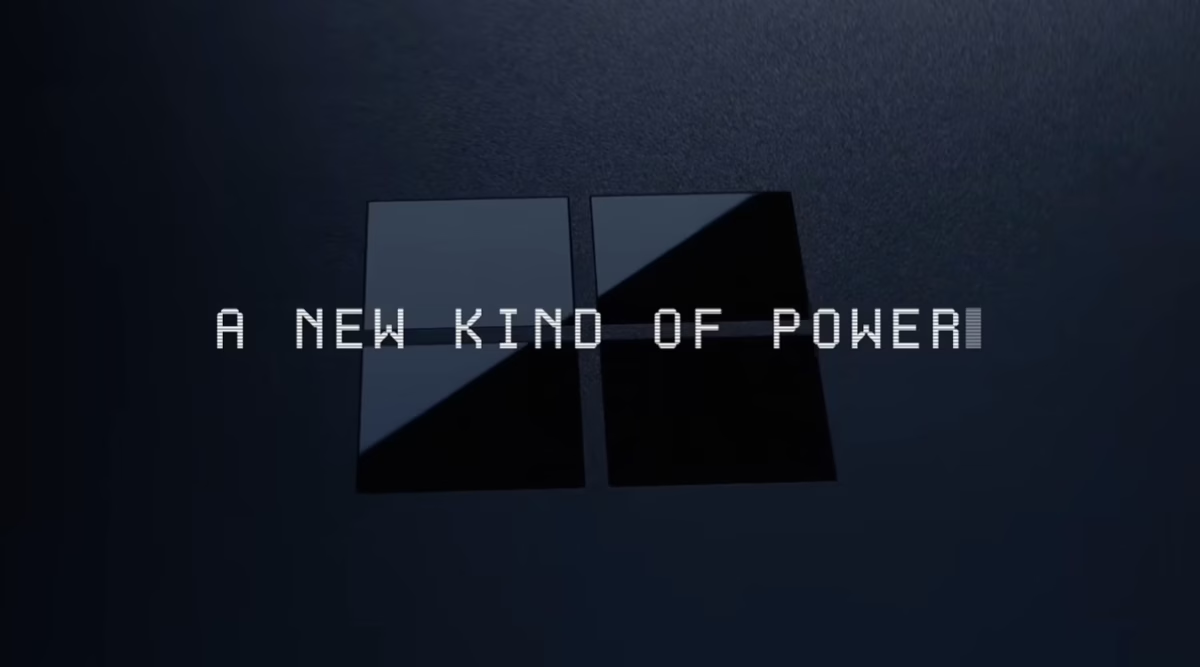
Microsoft officially unveiled the 15-inch Surface Laptop Ultra during a virtual launch event today, positioning the device as a direct competitor to Apple’s MacBook Pro. As part of a broader strategy to expand local AI processing capabilities, the new flagship introduces a custom architecture developed in collaboration with NVIDIA.
Table of Contents
Surface Laptop Ultra Specs: The NVIDIA Spark Superchip Explained
Targeted at creative professionals, data analysts, and software developers, the Surface Laptop Ultra aims to bridge the gap between a travel-friendly chassis and workstation-level performance. The system is powered by the newly announced NVIDIA RTX Spark Superchip, an Arm-based SoC that integrates a Blackwell RTX GPU with an up to 20-core NVIDIA Grace CPU. Rather than a standard hardware iteration, the transition to the Spark platform represents a significant architectural shift for Windows on Arm devices.
For users running local AI models, compiling large codebases, or rendering 3D environments, the hardware provides substantial on-device processing capabilities without relying on cloud infrastructure. While premium thin-and-light consumer laptops like the HP OmniBook X Flip 14 or the Lenovo IdeaPad 5 are designed for mainstream productivity, the Blackwell architecture specifically addresses the computational bottlenecks typical of standard ultraportable designs.
Surface Laptop Ultra Specs and Performance
Powered by the custom NVIDIA RTX Spark Superchip, the system features configurations scaling up to 128GB of unified memory and a 5,120-core Blackwell RTX GPU. This localized hardware synergy enables developers to execute intensive AI workloads—including models exceeding 120 billion parameters—without relying on external cloud computing. The comprehensive spec sheet below outlines the foundational architecture, display technology, and connectivity driving Microsoft’s most capable mobile flagship to date.
| Feature | Specification |
| Processor (SoC) | NVIDIA RTX Spark Superchip (Up to 20-core NVIDIA Grace CPU) |
| Graphics | NVIDIA Blackwell RTX GPU (Up to 5,120 cores) |
| AI Processing (NPU) | Dedicated NVIDIA AI acceleration (Up to 1 Petaflop local AI compute) |
| Memory | 24GB, 64GB, or 128GB Unified Memory |
| Storage | 1TB, 2TB, 4TB, or 8TB PCIe Gen 5 NVMe SSD |
| Display | 15.0-inch PixelSense™ Ultra mini-LED • 3:2 aspect ratio • 120Hz dynamic refresh rate • 2,000 nits peak HDR brightness |
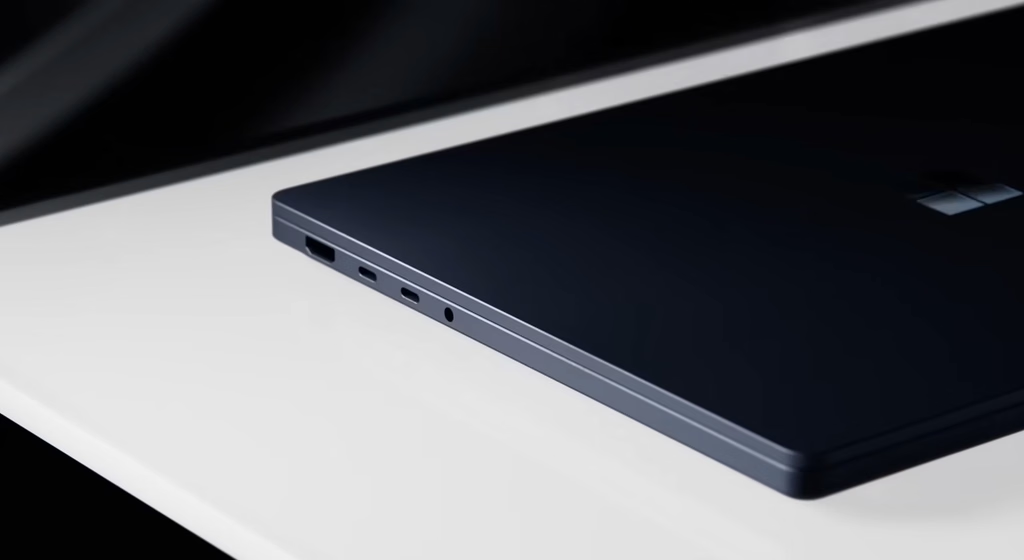
| Ports & Expansion | • 3x USB4 Type-C (w/ DisplayPort 2.1 & 140W Power Delivery) • 1x Surface Connect (magnetic charging) • 1x Full-size SD Express Card Reader • 3.5mm headphone/mic combo jack |
| Wireless Connectivity | Wi-Fi 7 (802.11be), Bluetooth® 5.4 |
| Camera & Audio | 1440p Surface Studio Camera with advanced AI framing Quad Omnisonic™ speakers with Dolby Atmos® |
| Operating System | Windows 11 Pro for Arm |
| Weight | 4.5 lbs (2.04 kg) |
| Starting Price | $2,599 USD |
Note: Since the NVIDIA Spark platform is Arm-based, it relies on high-bandwidth USB4 rather than Intel’s proprietary Thunderbolt standard, which is an important distinction for power users connecting external arrays. Specifications are as provided by Microsoft prior to product launch.
Surface Laptop Ultra vs. Apple MacBook Pro: The Architectural Rivalry
For over half a decade, Apple’s transition to custom ARM-based silicon has allowed the MacBook Pro to dominate the mobile workstation market, offering an untouchable balance of battery efficiency and unified memory performance. The introduction of the Microsoft Surface Laptop Ultra, powered by the NVIDIA RTX Spark Superchip, represents the first genuine architectural threat to Apple’s supremacy.
While both platforms now utilize an ARM-based CPU foundation paired with massive pools of unified memory, their design philosophies diverge when it comes to graphical and AI processing. Apple’s M-Series Max chips excel in video encoding, audio production, and overall power efficiency per watt. Conversely, Microsoft and NVIDIA have built the Surface Laptop Ultra explicitly around AI development and 3D rendering. The Blackwell RTX architecture brings native CUDA support and dedicated Tensor cores to a thin-and-light Windows chassis, offering a native ecosystem advantage for developers who rely on NVIDIA’s software stack for machine learning and intensive data compilation.
Here is how the new Surface Laptop Ultra stacks up against the current 16-inch Apple MacBook Pro footprint:
Spec Comparison: Microsoft vs. Apple Flagships
| Feature | Surface Laptop Ultra (15-inch) | Apple MacBook Pro (16-inch) |
| Architecture | Windows on Arm | macOS on Arm |
| Processor (SoC) | NVIDIA RTX Spark (Up to 20-core Grace CPU) | Apple M-Series Max (Up to 16-core CPU) |
| Graphics | Up to 5,120-core NVIDIA Blackwell RTX GPU | Up to 40-core Apple GPU |
| Maximum Memory | Up to 128GB Unified Memory | Up to 128GB Unified Memory |
| AI Acceleration | Dedicated NVIDIA Tensor Cores (1 Petaflop) | Apple Neural Engine (Up to 38 TOPS) |
| Display | 15.0″ PixelSense Ultra mini-LED (2000 nits peak) | 16.2″ Liquid Retina XDR mini-LED (1600 nits peak) |
| Weight | 4.5 lbs (2.04 kg) | 4.8 lbs (2.15 kg) |
| Starting Price | $2,599 USD | $2,999 USD ($4,399 for Max tier) |
The defining battleground between these two machines is software compatibility and workflow. Buyers heavily invested in Final Cut Pro, Logic, and iOS app development will remain tethered to the MacBook Pro. However, for professionals running local LLMs, training open-source infrastructure, or requiring enterprise-grade NVIDIA driver support on the go, the Surface Laptop Ultra finally offers a zero-compromise Windows alternative.
Price, Configurations, and Release Date
The Surface Laptop Ultra starts at USD $2,599 or CAD $3,899 for a configuration featuring an 18-core Grace CPU, a 5,120-core Blackwell RTX GPU, and 24GB of unified memory, with options scaling up to 128GB of memory and one petaflop of AI compute. Actual performance in heavy sustained workloads will ultimately depend on how effectively Microsoft’s redesigned thermal system can cool the 4.5-pound chassis without aggressive throttling under load.
The device is currently in pre-order starting today on October 7th and is anticipated to begin shipping on October 16th, 2026.